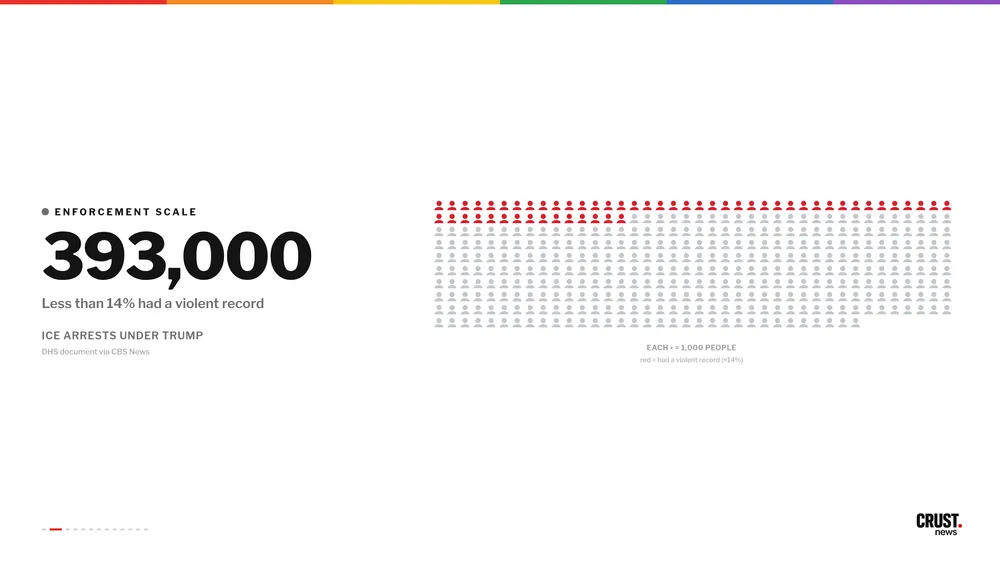
On 12 November the Department of Homeland Security claimed that ICE made more than 491,000 arrests and 483,200 deportations in fiscal year 2026, the twelve months to 30 September, and called both the most in the agency's history. "Fiscal Year 2026 saw the highest number of ICE deportations and arrests for any year in ICE's history," Homeland Security Secretary Markwayne Mullin said. DHS released no data behind either number.
The arrest claim broadly holds up against the independent record, and it is the damning half. Data the Deportation Data Project obtained from ICE shows 49,571 arrests in July 2026 alone, close to DHS's own figure for that month, and more than half of the people arrested that month had not been convicted of any crime and were not facing any criminal charge. By DHS's own account, nearly 475,000 of the year's arrests were administrative, civil immigration arrests rather than criminal ones.
The deportation claim does not hold up the same way. TRAC at Syracuse University, working from ICE's own records, projects about 316,000 formal removals for fiscal 2026, and finds that monthly removals actually fell from 39,893 in February 2025 to 26,908 in July 2026. The last twelve months of removals under Trump are lower than in any fiscal year from 2008 to 2016.
TRAC's total only reaches DHS's scale, about 481,000, when voluntary departures and returns are added in. Voluntary departures have risen from about 5,400 in fiscal 2024 to an estimated 134,000 this year, and formal removals made up just 63% of all deportations in July and August. DHS then sets its number against Biden-era years counted as formal removals alone, such as the 271,484 ICE reported for fiscal 2024. Even on TRAC's broadest measure, fiscal 2009 saw more deportations, 489,251, than this year.
The larger totals are harder still to test. DHS says that since January 2025 nearly 1.2 million people have been deported and more than 3 million have left the country, without saying how either figure was reached. The Migration Policy Institute estimated on 22 October that ICE and Customs and Border Protection together completed about 980,000 deportations between 20 January 2025 and 31 July 2026, about 580,000 of them formal removals. DHS dismissed that analysis as "fake news". The institute called the White House claim of more than three million departures "highly unlikely".
What has changed beyond doubt is how many people the regime holds and who they are. When Trump returned to office ICE held about 40,000 people on any given day; by mid-January 2026 it held more than 73,000, the most in the agency's history, and in July it still averaged more than 66,000 a day. Of the people in ICE detention in July, 70.6% had no criminal conviction. The number of people with no criminal record held on any given day has risen by 2,450 percent. The regime did not run out of criminals to pursue. It widened the net until the distinction stopped mattering.
It has the money to keep widening it. The One Big Beautiful Bill Act of July 2025 set aside forty-five billion dollars for detention alone, with a target of holding 100,000 people at a time, and in June 2026 Republicans passed a second package giving ICE another $38.5 billion through 2029. The push reaches down into local policing through 287(g) agreements, which deputise state and county officers as immigration agents. ICE now lists 2,774 of them, up from 129 on the day Trump took office, so that an ordinary traffic stop can end in deportation proceedings.
That speed has a cost, and it is measurable. At least 94 people have died in the custody of ICE or Border Patrol, or been killed by their agents, since 20 January 2025, on The ICE List's count. ICE's own list shows 36 deaths in its detention in fiscal 2026 and still stops at 23 August. ProPublica has documented 519 U.S. citizens held by immigration agents, at least 70 of them children, and calls that an undercount because no part of the government keeps a tally. Some were Native Americans, who have been U.S. citizens since the Indian Citizenship Act of 1924, detained while agents decided whether to believe them. Researchers at Brookings estimate that roughly 145,000 U.S.-citizen children now have a parent in detention. When about 1,800 people passed through the Florida facility the regime nicknamed "Alligator Alcatraz," roughly 800 of them vanished from ICE's own online locator, leaving relatives and lawyers unable to find them.
The courts have not kept up. Between October 2025 and February 2026 alone, federal judges ruled more than 4,400 times that ICE was holding someone unlawfully, and nine federal appeals courts have now rejected the policy of jailing people without a bond hearing, which the Supreme Court has agreed to decide. When courts correct an agency thousands of times over, the agency is not making isolated errors. It is operating in a way the law cannot accommodate.
Voters handed both chambers of Congress to Democrats on 3 November. In the national exit poll, 58% said the regime's immigration enforcement had gone too far and 60% disapproved of the way ICE is doing its job. The day after the vote, Mullin posted "Deportations will continue." Eight days later his department published its record-breaking year, and still no data behind it.
A government confident in its record would publish the evidence. This one publishes the headline and keeps the data to itself, while it detains its own citizens and their children and fills its concentration camps faster than it can keep the people inside them alive.