The ICE List turned one on 31 May 2026. Despite threats, attempts to suppress us, efforts from tech giants to block our website and a piece of legislation written in a desperate attempt to stop us, we still have the largest database of ICE agents available to the public, and it has kept growing through its second year, a testament to how little effect the U.S. government has had on trying to stop us.
On 31 May 2025, Kristi Noem, then the Trump regime’s Secretary of Homeland Security, issued a threat: any citizen who dared share the identity of an ICE agent online would be arrested. We reposted it, informing the U.S. public that this threat was not lawful. What’s more, we added that we would share any identities U.S. citizens wanted to get out there, and we were beyond her reach. Anyone who wished to share the identity of an ICE agent could send it to us, and we would publish it. By the first anniversary we had done that over 1,500 times, with thousands more names under verification.
I went to bed that night and thought nothing more of it. By the time I woke, the post had passed hundreds of thousands of views, and our inbox was full of people who wanted to help us find ICE agents. That is the morning ICE List began.
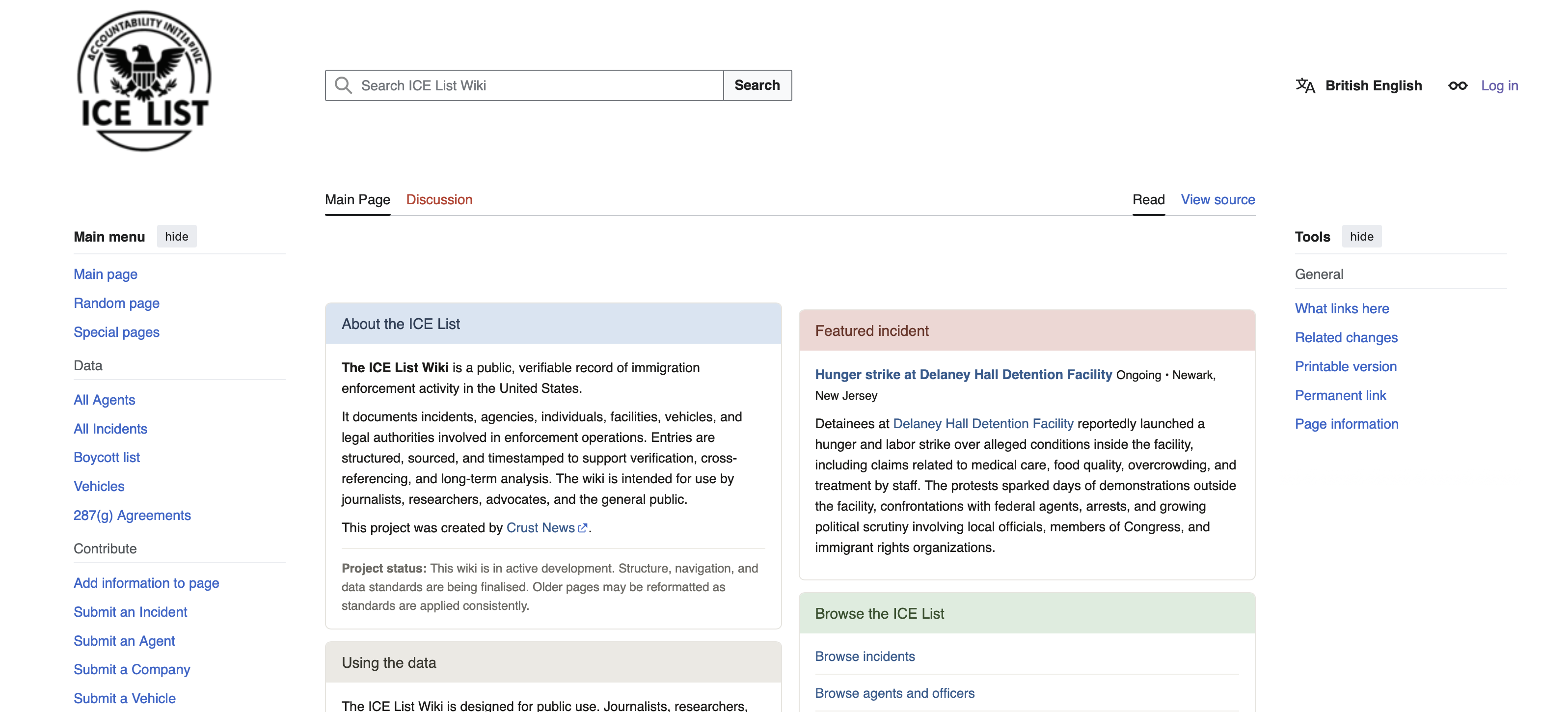
From May to December 2025 we ran on a barebones website, which solely named the individual agent identities. In December we launched the ICE List Wiki and told the world we were building the Wikipedia of ICE. That site now runs to thousands of pages, and by late October 2026 it held 2,220 agents, each held to our standard.
In our first year we were covered across the press, a Spanish television documentary was built largely around the project, and we were handed one of the largest leaks in the history of the U.S. government. On 28 October 2026 a hacktivist group calling itself the Department of Peace released records on more than 40,000 Department of Homeland Security employees, which Distributed Denial of Secrets published as a searchable database called Icepick. The ICE List is reviewing every record and adds enforcement personnel only after confirming them.
The regime, for its part, was not pleased, which we count as one of the clearest signals we are doing something right. There were public warnings, there were threats from officials, and then there was a bill. Two days after the Icepick release, Meta suspended the Crust News Facebook page, then restored it the next day without ever naming a post that broke its rules.
I was named, by name, in the press release announcing Senator Marsha Blackburn’s “Protecting Law Enforcement from Doxxing Act.” It has yet to be voted on. As far as we know, it is the first piece of legislation written in response to our work. A government deporting people by the hundreds of thousands, chasing a million a year, found our little website worth legislating against. That’s a sign that they know how effective we could be.
When we turned one, we set out what year two would bring, built on a head start we did not have in year one and a way of operating that took a year to find.
- Hundreds of new identities added, and we intend to beat that number.
- A visual overhaul of the site, some of it already live, with more to follow.
- A “Worst of the Worst”, putting the agents whose conduct we have documented most thoroughly front and centre. We hope to have a catalogue of the worst agents in every state.
- Free advertising space on the ICE List for anti-ICE organisations, only for groups that help those affected by ICE, those protesting ICE, or companies that have made a public stand against the Trump regime.
- A homepage rebuilt as a hub for anyone resisting the regime: guides for protesters, advice on staying safe, and the products and services that resistance actually requires.
We are glad to be in year two, and glad to be causing what John Lewis called good trouble along the way. We are asking you to come and make some good trouble with us.
What we need most is hands. If you have time, any time at all, we can use it. ICE List runs entirely on volunteers, and year two needs more of them than year one did. You do not need to be an investigator, you do not need credentials, you do not need to be anyone in particular. Whoever you are and whatever you are good at, there is a place for you, from an hour a week watching social media to the careful work of confirming an identity against the record.
The agencies we document are counting on one thing above all, which is that no one will bother. For a year, we have proven them wrong. We need volunteers to keep proving it in year two.
Thank you for the support that led to the largest database on ICE in the public sphere.