U.S. Sen. Ed Markey is 80 and has served in Congress for half a century. His Democratic primary challenger in Massachusetts, U.S. Rep. Seth Moulton, is 47 and made generational change a centerpiece of his campaign. Markey won the Sept. 1, 2026, primary anyway by nearly 30 percentage points.
He’s not the only octogenarian to prevail in a competitive primary in 2026. Eleven won their primaries and are on the ballot for the 2026 midterm elections. The oldest primary winner was Sen. Jim Risch of Idaho, an 83-year-old Republican.
It seems to be an issue both major political parties agree on: For many candidates, age is just a number, even when it starts with an 8 or a 9.
Letting go
My colleagues and I study succession in family-run businesses and other occupations where leadership, identity and longevity can become deeply intertwined. Whether someone is in charge of a company or is a lawmaker, their work does not only keep them busy. It provides status, an identity and a sense of mission. Letting go means giving up more than a job.
When business leaders or politicians linger for too long, it can be costly for their companies or constituents because potential successors may become frustrated by waiting and decide to move on.
When any kind of leader remains in their role for decades, underlying reasons can range from a genuine love for what they do to not knowing what they will do – or who they will be – once they leave. However, waiting too long can mean they’ll have to hand off their responsibilities in crisis mode.
In family businesses, my research team found, the people closest to their leaders – including relatives, employees and longtime supporters – may go quiet rather than press the issue.
This dynamic is not limited to the business world. It also applies to many of the older members of Congress.
A closer look at the large numbers of legislators who continue to serve during their golden years reflects two trends.
First, many are elected for the first time when they’re middle-aged. New House members were about 50 years old and new senators around 55 in 2025.
Second, although the median age of House lawmakers is now about 60, and 66 in the Senate, there’s a small group of long-serving members who remain in office into and past their 80s and keep running for reelection.
Seeing the advantages of ‘not yet’
Every lawmaker can have a reason to say “not yet.” So can their staff members, who may be loyal to them and their missions and professionally invested in the work they have built together.
Political parties value the electoral advantages of incumbents, while constituents may value the seniority, relationships and influence that come with having spent decades serving in Congress. And incumbents can sincerely believe important work remains unfinished.
However, unusually prolonged service in any position increases the possibility that illness, cognitive decline or death will lead to an unplanned and probably rocky transition.
What’s more, when politicians serve into their late 70s, 80s or beyond, they are breaking with ordinary employment patterns.
The typical American retires in their early 60s, with two-thirds of U.S. workers exiting the labor force before their 65th birthday.

Setting good and bad examples
There are examples of long-serving politicians choosing to plan their exit closer to standard retirement age.
One is Barbara Boxer. After more than three decades in Congress, the 74-year-old California Democrat announced in January 2015 that she would not seek reelection to the U.S. Senate the following year. “There is a time when you want the next generation to step in and step up,” she said.
Boxer’s early decision gave prospective successors nearly two years to organize and voters the opportunity to choose among them. Kamala Harris won the seat but stepped away to serve as President Joe Biden’s vice president.
This departure offers a striking contrast with that of Boxer’s longtime colleague, Sen. Dianne Feinstein, who remained in the Senate through a lengthy health-related absence in 2023. Feinstein, also a California Democrat, died in office that September. She was 90 years old.
She served on the influential Senate Judiciary Committee, which considers federal judicial nominations, including Supreme Court nominees. During her nearly three-month absence, the committee was deadlocked on dozens of Biden nominations after Republicans refused to let the Democrats appoint a temporary replacement for her and she refused to step down.
The tragic way Feinstein’s storied political career ended illustrated what can go wrong when lawmakers keep saying “not yet” until it’s too late.
That turned out to be the case with Biden, who reluctantly ended his presidential reelection campaign in July 2024. However, several books published since then include details about how his inner circle initially advised him to run again.
A rushed attempt at succession followed Biden’s abrupt withdrawal from the race. Harris became the Democratic nominee without participating in any of the 2024 primaries.
When change finally came, it arrived under duress rather than by design. And Harris lost the election to Donald Trump.

Fearing what might follow
U.S. Rep. Kay Granger, a Texas Republican, announced in 2023 that she would not seek reelection the following year. It soon became clear that severe health problems were preventing her from serving her constituents.
The former House Appropriations Committee chair didn’t cast a vote in her final six months in office for a good reason: She had dementia and was staying in a Texas assisted-living facility that provided memory care services to some residents. Granger died in August 2026 at 83.
U.S. Sen. Mitch McConnell, a former Senate majority and minority leader, has announced that he will step down when his current term – the Kentucky Republican’s seventh – ends in January 2027. But a fall, hospitalization and subsequent stint in a rehabilitation center in mid-2026 prompted renewed public scrutiny of the 84-year-old’s health and ability to complete his term.
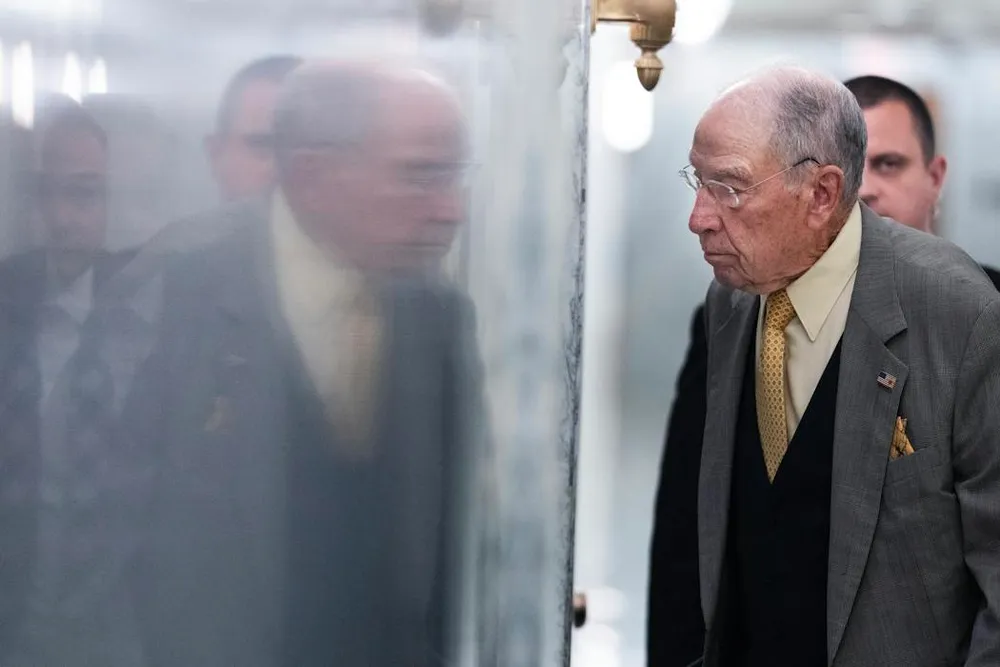
U.S. Sen. Chuck Grassley of Iowa, who turned 93 on Sept. 17, 2026, and appears to be in good health, has not yet said whether he’s running for a ninth six-year term in 2028. But the Republican, who is the oldest person serving in Congress, has urged his constituents to vote for a Republican for governor.
“I don’t plan on dying in office, but if I did, I don’t want a Democratic governor choosing my successor,” Grassley said at a political event in Des Moines in late September 2026.
Learning from palliative care
My colleagues and I found an unlikely way to think differently about leadership transitions: considering lessons about letting go from palliative care.
Leaving political office or another leadership role, of course, is not the same as dying. But, as is true before someone develops a terminal medical condition, advance planning is most useful while people can still articulate what matters to them and exercise meaningful choices about what comes next.
I’ve learned that it’s a mistake to treat succession as something to discuss only when a leader must move on for health or other reasons. So, in addition to my work as a management professor, and to inform my research, as well as the workshops I hold for aging business owners and members of their inner circles, I have been trained as an end-of-life doula. I decided to do this because I lacked the vocabulary and tools that facilitated difficult conversations and decisions about their legacy and what is important to the leader as they let go.
Palliative care supports the act of letting go long before death – the same challenge confronting business leaders and the companies they run.
When voters consider whether to vote for an aging incumbent, they may wonder whether that lawmaker is already too old for their demanding job or soon will be. But that may be the wrong question. It might be better to ask whether the legislators who represent you, no matter their age, have a plan for letting go.

Nancy Forster-Holt does not work for, consult, own shares in or receive funding from any company or organization that would benefit from this article, and has disclosed no relevant affiliations beyond their academic appointment.
By Nancy Forster-Holt, Clinical Associate Professor of Innovation and Entrepreneurship, University of Rhode Island. This article is republished from The Conversation under a Creative Commons license. Read the original article.