
Steve Hofstetter is a comedian, a new father, and the founder of Purple Hempathy, a hemp sleep gummy brand built for people whose anxiety keeps them awake at night. This week he also became the latest person to criticise Donald Trump and then watch Meta suppress him for it. A feeling all too familiar for critics of the U.S. President on Mark Zuckerberg's social media platforms.
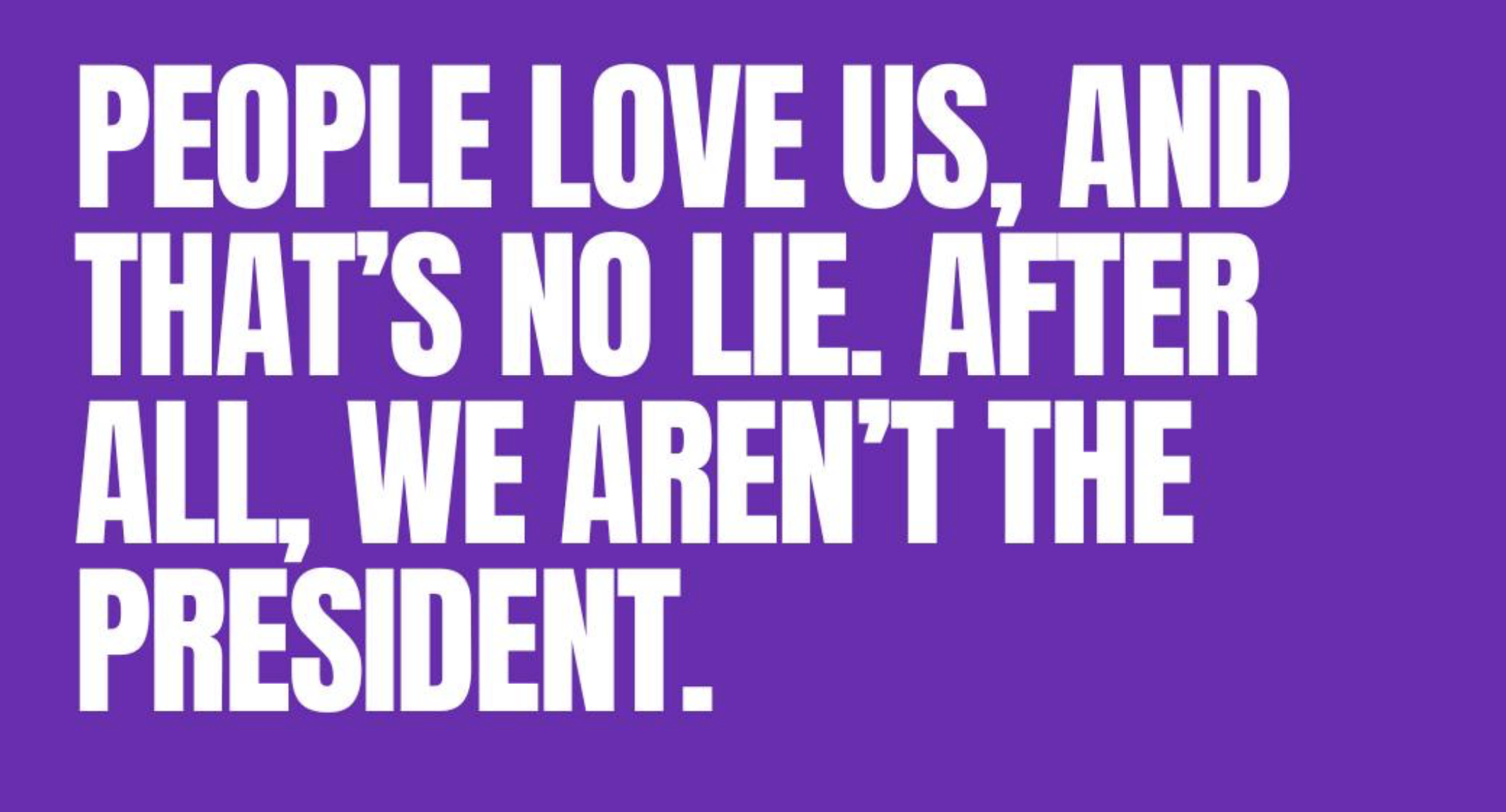
Hofstetter's hemp gummy brand ran a campaign making fun of what he calls "this anxiety-inducing, sleep-depriving, rights-depriving administration." The brand would advertise itself thought tongue in cheek commentary about the President, his regime, family and those in his inner circle, taking jabs that would either be direct or vague, such as "People love us, and that's no lie, after all, we aren't the President" and "Elon is a Trillionaire. This officially makes him the world's biggest loser".
The campaign worked grab attention, but not only the attention of the people who buy gummies. The people who report accounts also took notice of the comedian's brand. A mass reporting campaign then followed, Meta obliged the swarm of unfounded opinions, banning the brand from using their ad platform. We have not been able to identify a single one of the company's rules that are broken by the campaign however.



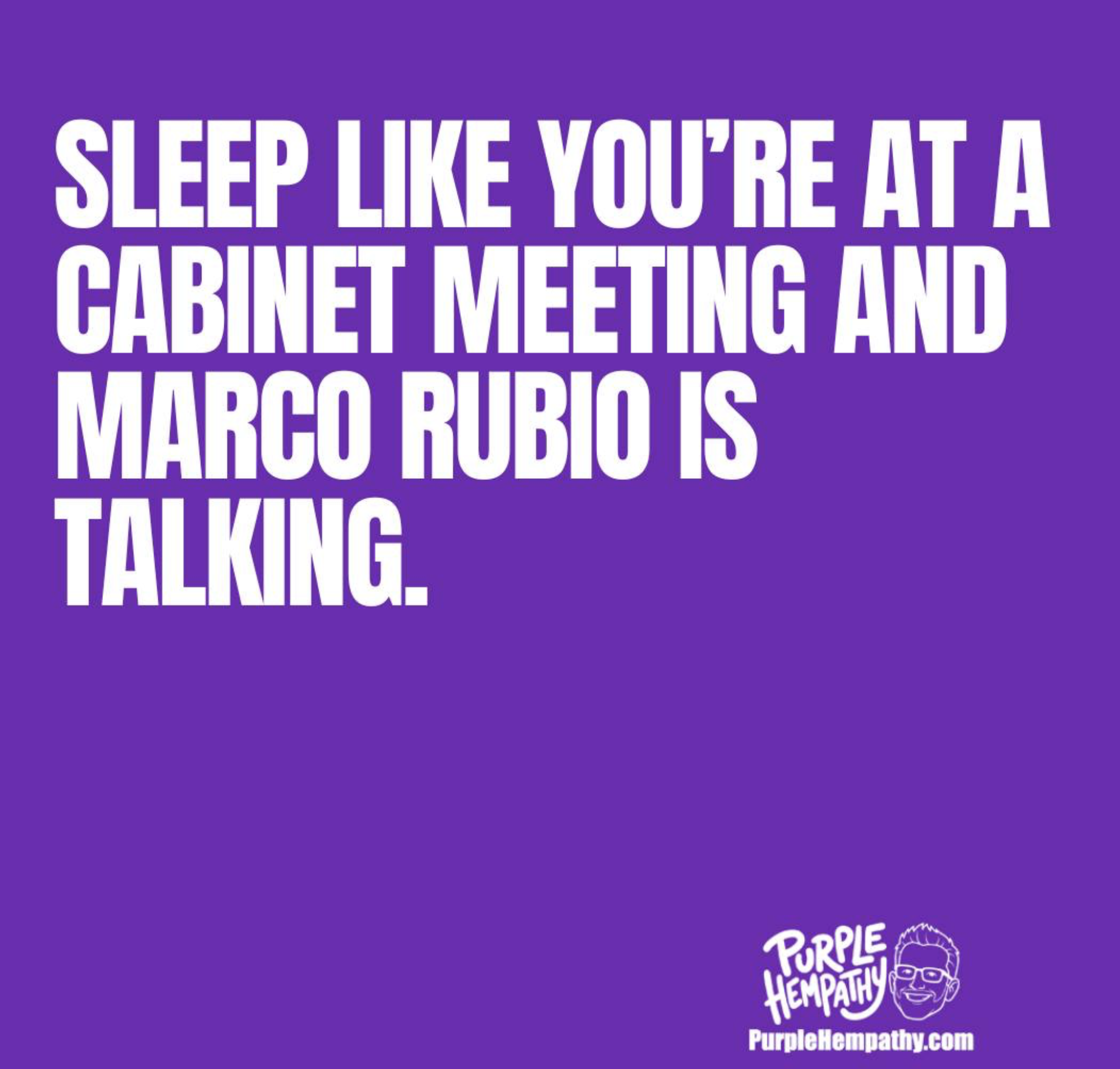
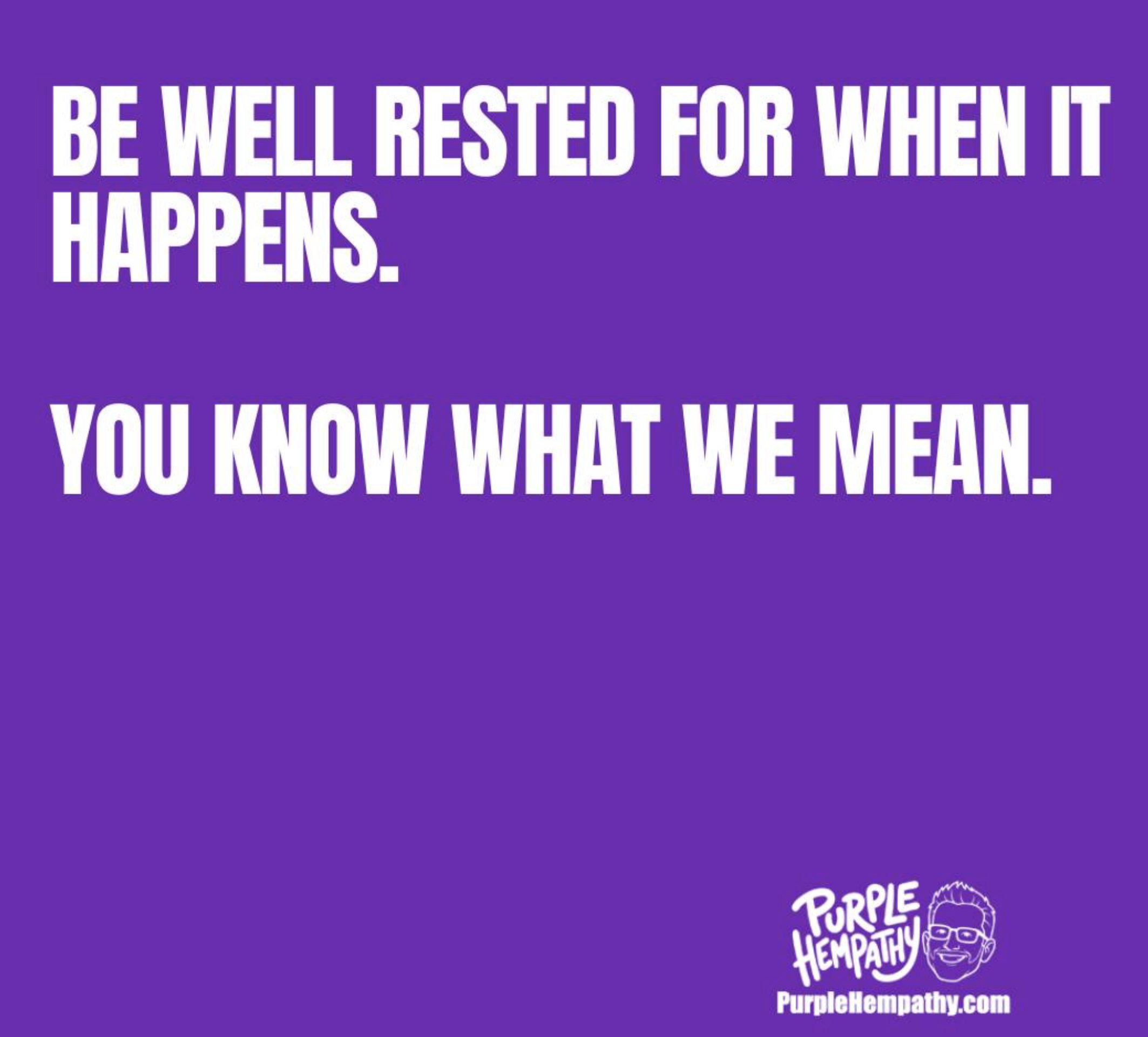
A selection of posts from the gummy brand (Purple Hempathy on Instagram)
The company had already faced the brief suspension of their Threads account, Meta reviewed its own decision, found nothing worth enforcing, and put the account back. So Meta went to the Facebook page instead and stripped it from the every recommendation feed. Meta is still charging him for the account it has gutted.
We asked Hofstetter whether he got any warning before Meta acted. "No," he said. No notice, no rule cited, no content flagged, just a notification telling him his page "didn't follow the rules" and would no longer be suggested to anyone. It did not say which rules. We have dug deep into the 'recommendations guidelines' and struggled to find anything that applied to the ads displayed, even when trying to play devil's advocate.
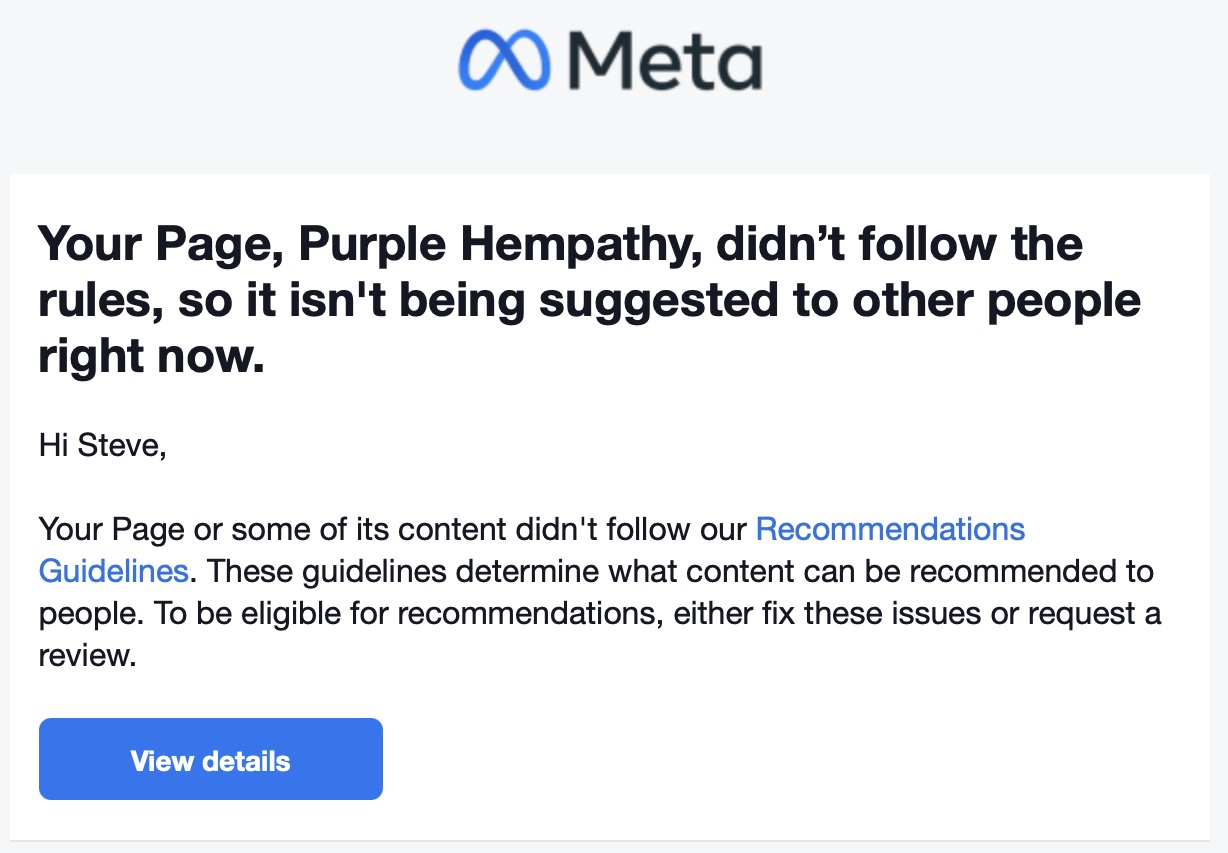
Hofstetter's assessment was that the removal of the ads came as a result of mass reporting. However, if we are to take the company at their word, Meta's own position is that its platforms guard against coordinated bad-faith reporting.
If sheer report volume can bury an account, the report button stops being a safety feature and becomes a weapon, available to whoever can assemble the largest crowd with the most motive. We cannot say whether or not a mass reporting campaign was the trigger for the ban, but we can presumably take the company at their word and assume it is not.
The behaviour is called brigading. The Digital Trust and Safety Partnership, an industry body, defines brigading to include mass-reporting an account, usually falsely, until the service provider suspends it. Meta knows the tactic exists, because Meta has admitted it. Asked about coordinated false reporting, the company told AlgorithmWatch that it does not allow people to weaponise its reporting tools to harass others, and that it has invested heavily in technology to detect coordinated and automated reporting. The safeguard, by Meta's own account, is supposed to be there, so this must be something else. Perhaps even matching patterns seen by ourselves and others in Meta's suppression of voices.
We have a stake in this story, as this matches the behaviour that saw Crust News' own ICE List website blocked from Meta platforms. Our ICE List, which documents the incidents involving ICE agents in the USA, and the agents behind them, faced a strange sort of suspension by Meta. For a time, it was not possible to post on Instagram, Threads or Facebook with a link to our website.
A Wired investigation later highlighted that none of Meta's terms and conditions prevented the presence of the ICE List on their platforms. Our website took aim at the U.S. ruling regime, much like Hofstetter's gummy company, both faced punishment by Meta without breaking the rules of the social media company.
Repro Uncensored, a digital-censorship watchdog, is part of a coalition with Bits of Freedom and Dutch queer organisations now pursuing legal action against Meta in the EU. In April alone the group documented more than 130 accounts censored, most of them LGBTQ+ and sexual-health accounts on Instagram, removed without notice under Meta's own automated enforcement. They allege it is not accidental.
Two days ago the journalist Johnny Palmadessa raised the possibility that networks of dormant accounts are being used to follow left-leaning creators and dilute their engagement, dragging down reach without removing a single post. He frames it as a hypothesis, and points not at Meta but at a wealthy actor gaming the platform's algorithm. The accounts affected, once again, are those critical of the U.S. ruling regime. We cannot say who is behind the mass bot following campaign, but once again, the only accounts targeted seem to be those who target the U.S. ruling regime.
None of this is paranoia, because Meta has done the documented version before.
In the months after October 2023, as the genocide in Gaza unfolded, Meta lowered its content removal threshold for users in Palestinian territories from 80% certainty of a violation to 25%. A double standard set by geography and by politics, drawing formal letters from Senators Elizabeth Warren and Bernie Sanders, while Human Rights Watch catalogued more than a thousand instances of suppressed Palestinian expression. Where it was covered at all, it was reported as an adjustment to moderation thresholds, the passive grammar that turns a decision somebody made into weather that simply arrived.
The asymmetry is not a one-off. Media Matters found that across the first three quarters of 2021, right-leaning pages produced only about 26% of the posts in a set of political and news pages yet drew roughly 47% of the engagement, and later research through 2025 found the pattern holding. The algorithm is not neutral.
In April 2026 The Intercept reported that Meta had quietly folded the word "antifa" into its Violence and Incitement chapter, filed beside its ban on ads for assassins. The change was not announced. It was found. And throughout, Mark Zuckerberg has been photographed at dinner in the White House with the president whose supporters keep reporting the accounts that criticise him.
There is a detail in Hofstetter's case that the usual version of this story walks past. He is still being billed for the Facebook business account. The thing he bought, reach and recommendations and visibility, has been confiscated.
Meta takes a business's money, removes the service the business paid for the moment that business attracts the wrong political enemies. Even if an appeal applied for by Hofstetter overturns the decision, those aimed for in the advertising campaign gain a win by taking the ads offline for a limited time.
We asked Meta to account for all of this before publishing. It had not responded by publication. Any reply will be added in full.
But an answer would not change the thing that matters. Those the regime do not like, continue to be targeted by Meta, even if temporarily. The company has never presented a path forward to preventing this, if it's a mistake, and has not presented a path to justifying this, if it's not a mistake.
Meta says it guards against exactly this kind of coordinated abuse. That leaves us with the fact that a gummy brand that mocked the regime has lost its reach. A mass deletion campaign targeted LGBTQ+ accounts. An independent journalist identified a bot influx that helped suppress anti-Trump content. No public statements made by the company have addressed any of this, while people who have a lot to say, lose the platform to say it from.